
By Zohaib Nawaz3 min read
AI for Small Businesses: What Actually Works (and What Is Just Hype)
Everyone is being told to “add AI”. Very few are told where it actually helps. A practical, hype-free guide to the AI features that save small businesses real time, and the ones that don't.
On this page
Small businesses tend to fall into one of two traps with AI. Some avoid it completely because it feels expensive and risky. Others buy a chatbot that confidently invents prices, policies and opening hours, and quietly damages their reputation.
AI is genuinely useful. It just isn't magic. Here is where it earns its keep, where it still fails, and how to start without wasting money.
Where AI genuinely helps
The best uses share one thing: a lot of repetitive text work that follows clear rules.
- Answering the same customer questions, day and night, from your own FAQ, prices and policies.
- Sorting incoming messages and leads, so urgent ones reach a person first.
- Summarising long documents, call notes or a month of customer reviews.
- Drafting replies, product descriptions or reports for a person to check and send.
- Searching your own documents in plain language instead of digging through folders.
In each case the AI handles the first 80% quickly, and a human stays in charge of the part that matters.
Where it still goes wrong
AI models are built to produce a confident answer, even when they don't have the right information. Left unchecked, they will invent a refund policy or a delivery date that sounds perfectly reasonable.
Be careful with anything legal, medical or financial, anything where being right 95% of the time is not good enough, and anything that depends on a personal relationship with your customer. Those need a person, with AI at most helping in the background.
The one rule that makes AI trustworthy
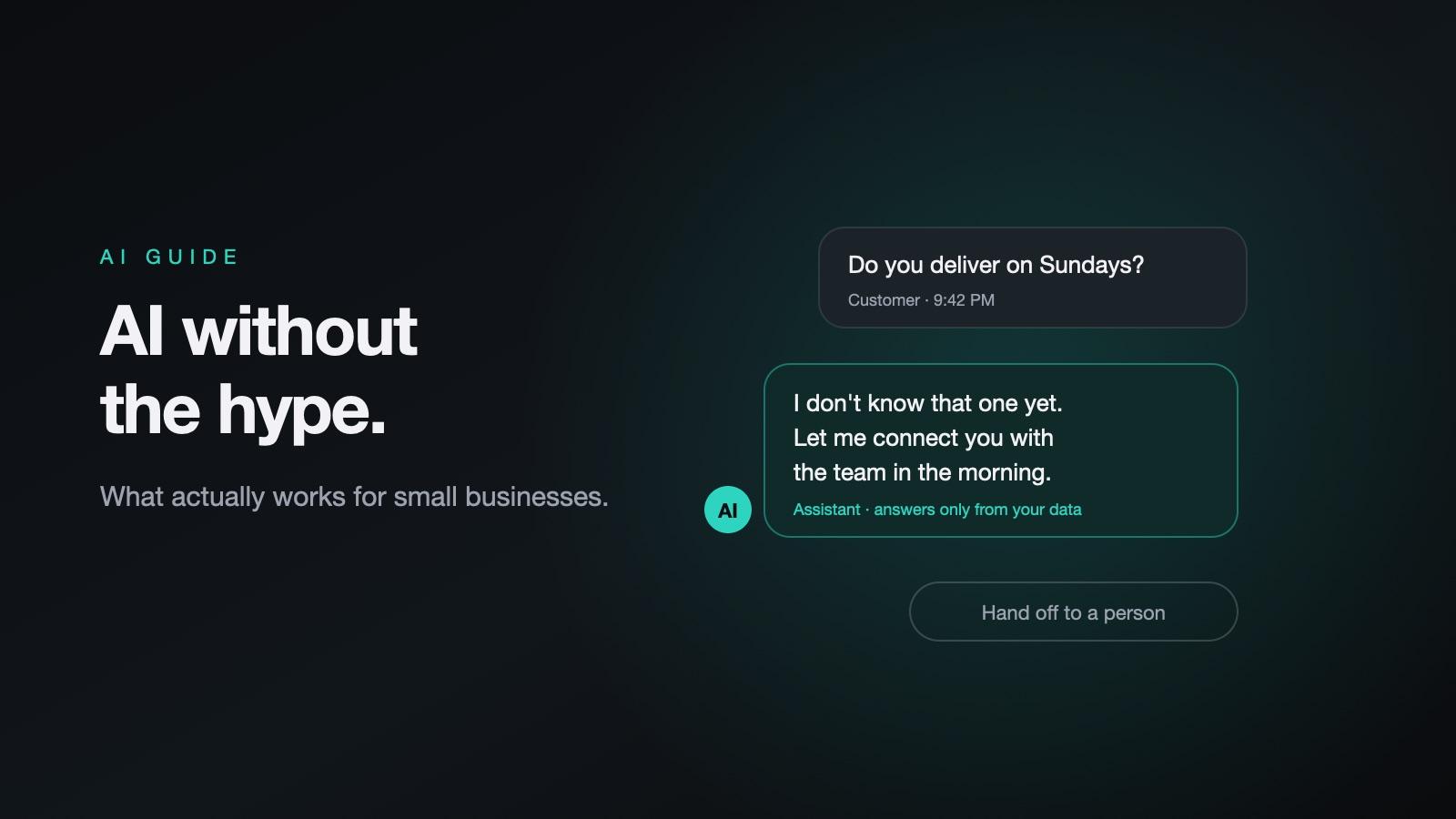
Ground it in your own information. Instead of letting the model answer from whatever it absorbed from the internet, give it your FAQ, price list and policies, and instruct it to answer only from those. When the answer isn't there, it should say so and hand the conversation to a person.
The assistant in the corner of this website works exactly like that. It answers questions about my work from a fixed set of facts, and when it doesn't know something it replies “I do not have that information currently” and points you to the contact page. I built my voice assistant, ZN AI, on the same principle, with the secret keys kept on the server so nobody can copy them from the browser.
A good AI assistant knows when to say: I don't know.
What it actually costs to run
Most AI services charge per use, based on how much text goes in and out. For short customer conversations on a fast, modern model, the cost per conversation is usually tiny. The bigger costs are building it well and keeping an eye on it.
Three habits keep the bill predictable:
- Set a monthly spending limit with your AI provider from day one.
- Use a smaller, faster model for simple jobs and save the expensive ones for hard tasks.
- Keep answers to common questions short and focused, so each conversation stays small.
Keeping your customers' data safe
- Keep secret keys on the server, never in the website code a visitor can open.
- Send only what the AI needs. It rarely needs a customer's full history to answer one question.
- Read your provider's data policy, including whether your data can be used to train their models, and choose settings that keep it private.
- Review conversations regularly, especially in the first month.
How to start without wasting money
- Pick one repetitive job that takes real hours every week.
- Measure it now: how many hours, how many messages, how many mistakes.
- Build the smallest version that uses your own information.
- Test it with real questions, including the awkward and tricky ones.
- Launch it with an easy hand-off to a person.
- Review it weekly for the first month, then decide whether to expand.
If a small version doesn't save time within a few weeks, a bigger version won't either. If it does, you will know exactly where to grow it next. That is how I approach every AI integration and AI assistant project: small, measurable and grounded first.
Questions people ask
Will an AI chatbot replace my customer support team?
No, and it shouldn't try. A well-built assistant handles the repetitive first line of questions and hands everything else to a person, so your team spends its time on the conversations that actually need them.
Can AI use my business documents without leaking them?
Yes, if it is built carefully. The documents stay on your server, only the small parts relevant to each question are sent to the AI, secret keys never reach the browser, and access is limited to the people who need it.
Which AI model should my business use?
For most small-business tasks, a fast mid-sized model is enough, and it is much cheaper than the largest ones. More important than the brand is keeping your own data and instructions portable, so you can switch providers later without starting over.